
Dark spots or a musty room after a leak
Mold After Water Damage in Canton, GA
Mold follows materials that stay wet, so the leak and the drying come before any scrubbing. In Canton, Hickory Flat, Free Home, Sixes and Macedonia, call (678) 658-3988 when dark patches cover more than about 10 square feet, the water was sewage, or the same wall keeps getting wet.
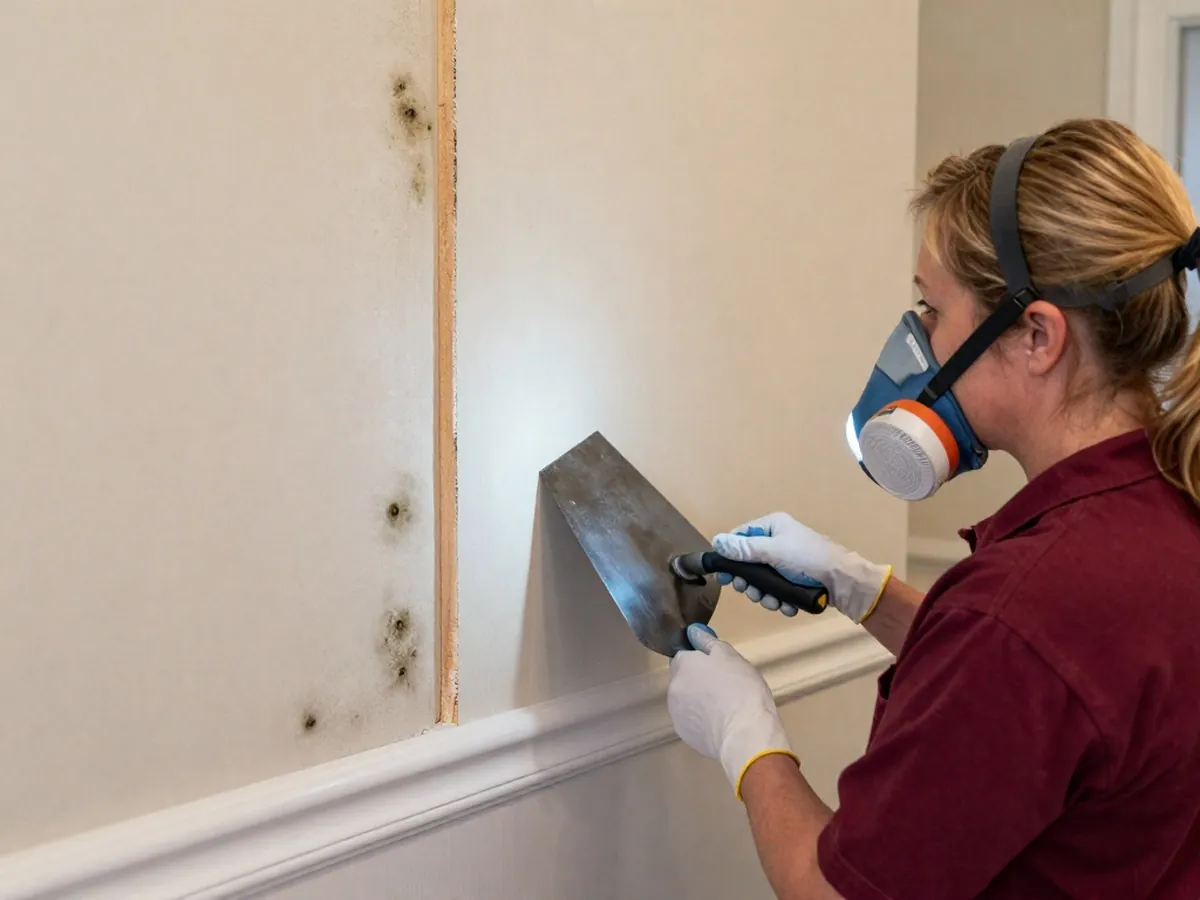
The 24-to-48-hour window and a gauge with no dry month
In the brief EPA guide, 24 to 48 hours is the window: wet materials dried inside it, and mold in most cases will not grow. UGA's checklist repeats the figure. The Canton gauge averages at least 3.49 inches of rain in every month, so no season gives a head start. Mississippi State puts a closed wall's dry-out at 4 to 6 weeks or more, a long stretch to leave a damp stud bay shut.
What the contractor can look at
- Call (678) 658-3988, point to where the dark patches are and what wet them, and a visit gets set up.
- A look at how far the moisture goes, behind the visible patch and through the layers under it.
- A check of the water source. EPA's cleanup page treats the job as unfinished while the water or moisture problem remains.
- A call on porous materials. EPA's examples are ceiling tiles and carpet, which may be thrown out when mold has grown through them.
- A look at the heating and cooling system if it may have taken in moisture, since EPA says not to run it if you know or suspect contamination.
- Repair options, and which parts bring paperwork; the offices page lists the desks.
Step back and get help if
Anyone short of breath, wheezing or dizzy in a damp room: move them out into fresh air and phone 911 if it does not ease. FEMA notes that mold can worsen asthma and other breathing conditions.
Wiring or outlets standing in water: stay out and leave the switches alone. Sparks or a burnt smell mean get out of the house and phone 911 or the electric utility.
A ceiling over the damp room that has started to sag or bulge: do not stand beneath it, and keep the room closed to people and pets.
A gas smell: step outside without touching a switch. The emergency numbers are 911 and, for the gas utility, 877.427.4321.
Three shortcuts that bring the patch back
Scrubbing the patch and leaving the leak. EPA's advice is to correct the water problem first, or the mold is likely to come back.
Bleaching a sewage-wet surface. EPA sends sewage and contaminated-water jobs to a professional experienced with them.
Turning on the system to dry the room. EPA cautions against running a heating and cooling system that is known or suspected to be contaminated.
Looks from the doorway
Keep to checks that feel easy from the doorway. None of them needs a tool, a ladder or a step into standing water.
An inexpensive meter will show the humidity in the room. EPA's brief guide gives 60 percent as the ceiling and 30 to 50 percent as the target.
Look for condensation on windows and cold pipes, which EPA lists as a sign of high humidity.
Find the water that fed the patch. EPA says cleaned mold returns if the water problem stays.
Photograph each dark patch with a ruler beside it and mark its edge in pencil to see whether it grows.
A way to size up a patch before dialing
Measure the patch against a 3-foot by 3-foot square drawn on paper. Larger than the square, or more than one patch, and EPA's own advice moves toward a professional.
Ask what wet it. Clean water from a supply line is one case. Water from a drain or a flood is another, and the EPA page treats it differently.
Ask whether the source is repaired. If not, the repair comes first.
Then call (678) 658-3988 with the size, the source and the date the leak began.
Three short answers
How urgent is a mold patch after a leak?
Red: someone struggling to breathe, wet wiring or a sagging ceiling. Get out; 911 or the utility comes first. Amber: the patch is growing, covers more than about 10 square feet, or came from sewage; use the call button. Green: a small spot where the leak is repaired and the area is dry.
What size of mold patch can a homeowner scrub?
On EPA's cleanup page, a patch smaller than about 10 square feet (a 3-by-3-foot square, give or take) is often a homeowner job, and anyone with health concerns is pointed to a health professional first. For damage from sewage or other contaminated water, it advises a professional experienced with that kind of water.
Does the line cover Hickory Flat, Free Home, Sixes and Macedonia too?
Yes. A mold question in Canton, Hickory Flat, Free Home, Sixes, GA and Macedonia, GA goes to the same contractor. Outside those five places, the line does not reach.
No rule for patches in the pages read here
The county and city pages opened for this site say nothing about mold work, so the paperwork question is about what gets rebuilt afterward, such as removed drywall and trim. Cherokee County's Development Service Center, (770) 721-7810, and Canton's Building and Safety Services, 770-704-1551, are the desks to ask. The offices page names both.
Side notes
- EPA, A Brief Guide to Mold, Moisture and Your Home (updated 18 Feb 2026)
- EPA, Mold Cleanup in Your Home (updated 4 Jun 2026)
- University of Georgia Extension, Mold and Moisture Home Inspection Checklist (Circular 1083, reviewed 1 Mar 2023)
- FEMA, Tips for Safely Returning to a Fire- or Flood-Damaged Home (13 Jul 2024)
- CDC, Safety Guidelines: Reentering Your Flooded Home (updated 24 Aug 2026)
- Mississippi State University Extension, Disaster Relief: Home Cleanup and Renovation for Walls (P3837)
- Texas A&M AgriLife Extension, Cleaning Flood-damaged Homes
- NOAA NCEI, U.S. Monthly Climate Normals 1991-2020, Canton GA station (USC00091585)
Checked 1 Nov 2026